Metacafe Inks Mobile Video Deals
 Video entertainment provider Metacafe announced agreements with mobile multimedia service providers Buongiorno, Dyuna and Mobile Streams to deliver short-form video content to handsets.
Its VideoRank technology spotlights recommended clips, while its Producer Rewards program relies on viewer response to reward creators for popular efforts. "The short videos featured on Metacafe are well-suited to mobile distribution--perfect for enjoying a quick entertainment break, regardless of time or place," said Metacafe CEO Erick Hachenburg in a prepared statement.
"Our sophisticated approach to programming, which automatically showcases the videos our large and global audience finds most entertaining, ensures a good user experience in the mobile environment, where searching for a video is not practical," he added.
Buongiorno is a trendsetting, independent mobile media and technology company driving the burgeoning cellphone entertainment and personalization industry. With the recent acquisition of iTouch, it becomes No.1 player in the mobile entertainment market worldwide.
It partners with over 100 leading cellular carriers, as well as with media and Internet companies in over 53 countries on 5 continents to distribute, package and create music, games, videos, wallpaper, ringtones, chat, user-generated services, TV voting, quizzes, and to sell advertising.
Buongiorno helps companies market through proprietary labels, and sells directly through its popular Blinko brand. It distributes across the U.S., Europe, Russia, India, the Far East, South America and Mexico, the Middle East, Africa and China. Its reach is already exceeding 840 million customers. [FierceMobileContent/FierceWireless]


Video Game Market Stronger Than Ever
 The struggle for video game market share seems to have been good for gaming overall.
"While I wouldn't count on similar growth in 2008, I would expect to see 2008 increase over 2007, with more growth (proportionately) coming from software sales," said Anita Frazier, analyst at NPD.

As for the consoles themselves, Microsoft's one-year head start on its rivals and popular online gaming service kept it in front.
NPD said that game accessory sales were up 37% to $621.6 million. The booming market is good news not only for video game marketers, but also for marketers and advertisers looking to advertise in the games themselves. eMarketer projects that about two-thirds of a billion dollars will be spent on such ads in 2008.
Online Video Revenue To Approach $4B
 The research company said that although the United States had the most developed online video market so far, online video revenue for the country would only reach $280 million in 2007, accounting for 1% of the total home video market.
"By 2011 online video in the US will represent 8% of total home entertainment revenues, with Western Europe close behind at 7%," said Mai Hoang, analyst at Understanding & Solutions.
"What's more, multiple formats will coexist in the future, and no one format will control the home entertainment landscape, quite unlike the domination of DVD since the demise of VHS," Ms. Hoang said.
"The new generation of high definition video formats will also help to shore up packaged media's presence within home entertainment revenue streams," she said. [eMarketer]
2012: Mobile Video Messaging Opportunity Will Reach $10 Billion
 Mobile video messaging services are at the center of the technology convergence that is helping mobile customers realize greater levels of self-expression and online community participation.
According to principal analyst Dan Shey of ABI Research, “Mobile video messaging is perfectly positioned to take advantage of the convergence of increased mobile device capabilities and consumers’ desire for broader communication options beyond voice. In fact, we expect the opportunity for mobile video services to produce a compound annual growth rate of nearly 60%, amounting to $10 billion in 2012.”
But mobile video messaging is just part of a much bigger portfolio of mobile video services that includes video calling, video sharing, and mobile TV services. The complexity of the mobile video value chain affects mobile equipment and service suppliers not only in industrialized countries but also in developing regions of the world.
Given such complex conditions, ABI Research has created forecasts for uptake of mobile video messaging and telephony services for eight regions of the world: North America, Western Europe, Asia Pacific-Developed, Eastern Europe, Latin America, Asia Pacific-Developing, Middle East, and Africa.
The industrialized parts of the world with the highest concentration of advanced video devices will see the greatest uptake of mobile video services. However, don’t discount the developing regions. Says Shey, “Social networking sites such as Orkut are very popular outside of the US and Europe. Mobile video messaging will facilitate mobile content delivery using a growing base of video recorder devices and established 2.5G networks.” [ABI Research]
Global Mobile TV and Video Get Real
Will we all tune into our phones at the same time?
Infonetics Research's "Mobile Video Devices, Services, and Subscribers" report published May 9, 2007 found that revenue from mobile video is set to increase.
The firm estimated that service provider revenue from mobile video services is expected to triple to nearly $ 200 million worldwide in 2007, after already growing 317% from 2005-2006.
The number of paying subscribers worldwide for 2010 was projected by Infonetics to reach 46 million.
Mobile video involves shuttling video content from a server to an individual handset on demand. Mobile TV works more like broadcast television, with TV tuners embedded in mobile phones.
A separate study by Screen Digest focusing on mobile TV estimated that associated revenues for that technology would reach Eur4.7 billion, based on 140 million subscribers worldwide in 2011.
David MacQueen of Screen Digest said that there are good reasons why carriers will focus on mobile TV over the next several years.
"Regulatory and competitive pressures have pushed down the average consumer spend on voice and messaging," said Mr. MacQueen. "Mobile operators must now look to new content offerings to deliver the business growth they've enjoyed over the past decade."
Read more
Mobile Video Revenues is Forecasted to Triple in 2007
A new report issued by market research firm Infonetics Research says operator revenue from mobile video services jumped 317 percent to almost $200 million worldwide in 2006, with revenues expected to triple in 2007. According to Infonetics, global mobile video subscriber totals increased more than 300 percent between 2005 and 2006, and should exceed 46 million users by 2010.
The Asia Pacific consumer market will lead with 57 percent of the world total in 2006, followed by the Europe/Middle East/Africa market at 31 percent and North America at 10 percent--Infonetics cites the low costs of SK Telecom and NTT DoCoMo's respective mobile video services as the driving force behind the Asia Pacific market's prowess.
"We will continue to see healthy growth in the mobile video services market as mobile operators expand the bandwidth of their existing 3G networks through HSDPA and MBMS, roll out dedicated broadcast networks, and deploy new mobile video service delivery platforms," said Infonetics directing analyst for broadband and IPTV Jeff Heynen in a prepared statement.
"Competition among service providers will keep subscription prices lower in the long term, but that revenue will be supplemented by incremental service revenue from on-demand viewing. We expect to see a spike in mobile video service revenue in 2008 due to the Summer Olympics in Beijing which, similar to last year's World Cup, is a deadline for many operators to get their mobile video services up and running." [FierceMobileContent]
Young Men Dominate Mobile TV Use
According to data from Telephia, US mobile video subscribership reached 6.2 million in the fourth quarter of 2006.
That figure is up 145% from the first quarter of 2006. The firm estimates that revenues from mobile video subscriptions totaled $148 million in Q4 2006, up 188% from the start of the year.
Mobile TV viewers are overwhelmingly male. In fact, 70% of video mobile subscribers are men, although they actually make up less than half of all mobile subscribers.
Mobile video also attracts young users, with 62% of mobile video subscribers between the ages of 18 and 36. That age group represents only a third of all mobile subscribers.
Mobile TV is growing worldwide. "People are spending money to get entertainment on the move," said Graeme Oxby of 3, a mobile video company, speaking at the Broadcast Mobile TV Congress in London. "Mobile TV provides broadcasters with opportunities to do new things that they might find difficult on a normal broadcast platform."
Mr. Oxby also said the keys to continued growth of mobile TV were simpler pricing, easier-to-use services and more made-for-mobile content.
Read more
Premium Video to Reach $277 Billion in 2010
Revenues from pay TV, mobile video, DVD, broadband video and theater/box office receipts will reach $277 billion by 2010, up from less than $200 billion in 2006, according to iSuppli Corporation.
If advertising revenues are added to premium video sales, the total market amounted to approximately $370 billion in 2006.
Pay-TV services, especially from Internet protocol television (IPTV), will drive much of the growth. IPTV is the fastest-expanding segment of the pay-TV market, with revenues expected to increase to $23.5 billion in 2010, rising at a compound annual growth rate (CAGR) of 103% from $681 million in 2005.
DVD sales are actually expected to decline by as much as 20% during the next four years. Hollywood studios are running out of new content to sell, even as half of their revenues now come from DVDs. Consumers are also becoming price-sensitive, and are increasingly reluctant to spend $20 to buy DVDs outright when renting is an option. [eMarketer]
Mobile TV/VOD to reach $18B by 2010
A new study issued by research firm Understanding & Solutions anticipates mobile television and video on demand revenues will increase 800 percent between 2006 and 2010, yielding global revenues of $18 billion by the beginning of the next decade. Of that amount, mobile TV profits will exceed mobile VOD by a margin of nearly four to one, generating roughly $14.3 billion and $3.7 billion respectively.
"Whereas digital TV is all about choice, mobile TV is about favorites and performs well when it's addressing local and national tastes," Understanding & Solutions consultant David Sidebottom said in a prepared statement. "'Dip in, dip out' and short-form are important mobile content attributes, and much mobile TV usage will be competing with mobile games, web content and podcasting."
According to Understanding & Solutions, DVB-H will emerge as the dominant mobile video solution thanks to its robust error correction, power efficiencies and capacity to carry up to 80 channels.
Source: FierceMobileContent. For more on the mobile TV report, read this release
Related articles: Mobile entertainment to reach $77B by 2011
Chinese mobile video to jump with 2008 Olympics
Staying in the Asia-Pacific region, a new ABI Research study forecasts the Chinese mobile video market will grow to more than 32 million users in 2008, a spike attributed to subscriber interest in the Beijing Summer Olympics. According to ABI, roughly 27 percent of the consumer base will access mobile video via broadcasting technology, while the remaining 73 percent will employ unicast streaming technology.
Ongoing standards debates will no doubt impact the Chinese market, ABI added. "It is likely that local media groups and TV stations will deploy DAB [the first phase of Chinese mobile multimedia broadcasting standards] initially, and implement T-DMB [a terrestrial version of SK Telecom's mobile video format] at a later date," ABI research director Jake Saunders said in a prepared statement. "The Chinese government will give preference to a standard that will be used in the 2008 Olympics, and DAB has been listed as one of the broadcast services that will be available at the Beijing Games."
Source: FierceMobileContent and for more on Chinese mobile video growth read this release
Online Video Becomes a Real Business
Welcome to the MoneyTube.
eMarketer estimates that more than one-third of the total US population ages 3 and older viewed video on the Internet at least monthly during 2006, and in three years more than half of all Americans will be part of the online video audience.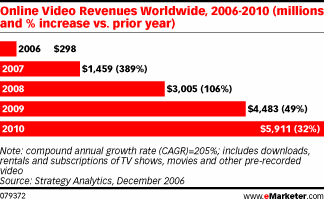 "At this point, nearly 60% of all Internet users watch video regularly, and that share will increase to over 80% by the end of 2010," said David Hallerman, eMarketer senior analyst and the author of the new Internet Video Audience report.
There were will be 108 million US Internet video users this year, and 157 million by 2010.
But do millions of viewers constitute a market?
According to "The Video Store Goes Virtual: The Global Outlook for Online Video Sales" report from Strategy Analytics, yes, online sales of television shows, movies and other prerecorded video products will become a billion-dollar business — next year.
Although video-download sales made through iTunes and other online sources will total just $298 million this year, Strategy Analytics predicts that by the end of 2007 the online video market will grow to $1.5 billion.
"2007 will be remembered as the year in which online sales of prerecorded video finally become a real business," said Martin Olausson of Strategy Analytics. "Just like with music, online delivery of video content is now emerging as a viable and increasingly important distribution channel for content owners."
By 2010, the report estimates that global revenues from online video sales, rentals and subscriptions will reach $5.9 billion, and account for 8% of total home video industry revenues.
Read more




Flickr Photostream-


- Copyright © 2008-2011 ICT & Internet Business. All Rights Reserved. Powered by Blogger
- Back To Top
- Log in
- Blogger
- Home
Recent Comments-